
Eco-Friendly Cleaning Chemicals for Stone, Tile, and Pavers
You grab a bottle that shouts "natural" at the hardware store, then freeze. Are those eco friendly cleaning chemicals actually safe on your limestone patio or slate bathroom floor, or are they the fast track to etch marks and a headache? The front label feels friendly, the back label reads like a riddle, and your weekend project hangs in the balance.
Here is the simple question that unlocks the shelf: what does "eco-friendly" actually mean for cleaners built for stone, tile, and pavers? Not the marketing story, the real thing. By the end of this guide, you will know which ingredients to avoid, which certifications to trust, and what actually cleans without chewing up your surfaces or polluting your drain. This guide distills field experience from Canadian job sites alongside manufacturer and certification guidance so you can make a clear, confident pick.
Why your stone surfaces deserve better than conventional cleaners
The hidden damage harsh chemicals leave behind
Bleach, ammonia, and strong acids clean aggressively, then send you a bill you do not see right away. On calcareous stones like marble, limestone, and travertine, acidic cleaners etch the surface, turning a smooth finish into a dull patch. On sealed concrete, porcelain grout, and engineered stone, high-pH or oxidizing formulas can strip sealers, bleach grout lines, or haze a finish you paid good money for.[1]
That damage is not just cosmetic. Once a sealer is compromised, stains penetrate faster and cleaning becomes a grind, so you re-clean and re-seal more often. Aggressive chemicals shift costs from this weekend to more weekends, and they can shorten the life of your surfaces. It is the cleaning version of stepping on the gas while riding the brakes.[1]
For real-world examples and common mistakes in North America that lead to this kind of damage, see The Pitfalls of Improper Stone Floor and Counter Cleaners in Canada for practical case studies and corrective steps.
The environmental side of the equation
When you rinse a patio, balcony, or garage floor, the water does not disappear. Phosphate-loaded or solvent-heavy runoff flows into storm drains and local waterways; phosphate runoff has contributed to algal blooms in the Great Lakes watershed and other natural waters.[2] Indoors, higher-VOC products off-gas into your bathroom or kitchen, which matters if you have kids, pets, or a small condo with limited ventilation.[3]
So there are two goals every time you clean: protect the surface and protect what happens after you pull the trigger on the sprayer. A good cleaner respects stone and the stream, not just one or the other. That is the benchmark used by credible guidance and certifications.[4]
Ingredients to avoid in any stone or tile cleaner
The surface-damaging culprits
If a label waves any of these in your face, you are looking at a potential etch, haze, or sealer-strip moment. Think of this as the "nope" list you screenshot for the store aisle.
- Chlorine bleach: oxidizes stains but can strip sealers, lighten grout, and create dangerous fumes if mixed.
- Ammonia: strongly alkaline, can dull finishes and degrade some polymer-based sealers and grout.
- Strong acids: hydrofluoric, muriatic, or heavy-acid blends marketed for "cement/grout removal" can etch marble, limestone, and many engineered stones.
- High-alkaline degreasers (routine use): avoid everyday cleaners above roughly pH 10; reserve stronger alkalis for targeted, professional use with manufacturer approval.[1]
There are edge cases for pros, like carefully buffered acids on specific porcelain haze, yet those are targeted, one-time processes with neutralizing steps. For routine maintenance, stay near neutral pH and avoid the extremes that wreck finishes.[5]
The environmentally harmful ones
This is the "it cleans, but at what cost" group. If you see them, put the bottle back and keep walking.
- Phosphates: boost cleaning power, then can boost algae growth downstream.[2]
- Alkylphenol ethoxylates (APEs): surfactants linked with endocrine disruption in wildlife.
- Quaternary ammonium compounds (quats): slow to biodegrade and not needed for everyday stone cleaning.
- Synthetic fragrance and "parfum": often hide phthalates and mystery mixtures that add scent, not cleaning.
- Triclosan and similar antibacterials: persistence and resistance concerns, unnecessary for routine surface washing.
Plain-language rule: if the ingredient list looks like a chemistry lab flex, it is not a daily stone cleaner. Save disinfectants for actual disinfection tasks, not for washing your patio every weekend. For a focused list of problematic components and why they matter, read this guide to cleaning ingredients to avoid.
Why "natural" on the label does not mean safe
In Canada, words like natural, green, plant-based, and eco-friendly are marketing language, not an automatic gold star. They must not be misleading under labeling laws, but there is no special green stamp from Health Canada approving those claims.[6] A cleaner can be plant-based and still too acidic for marble.
That is why you will see us talk about certifications and full ingredient disclosure in a moment. Proof looks like clear ingredient listings, a neutral-to-mild pH range, and third-party review. Proof beats vibes when it comes to choosing greener cleaners built for hard surfaces. For a practical consumer perspective on how to shop for genuinely greener cleaners, see this how to shop for green cleaners guide.
How to decode eco labels on eco friendly cleaning chemicals (and which ones to actually trust)
The certifications that mean something
Trust product-specific, third-party programs that review ingredients and performance. The big three for North American shoppers are ECOLOGO, Green Seal, and EPA Safer Choice.[7][8][9] Think of them like a nutritionist who checks every ingredient in your spray bottle, not just the feel-good claim on the front.
ECOLOGO has Canadian roots and looks at a product's life cycle. Green Seal sets performance and safety standards many institutions rely on. EPA Safer Choice screens every ingredient for human and environmental health, and Design for the Environment covers antimicrobial products under similar criteria. These labels trade marketing for math, and that is good.
Labels that tell you something else
B Corp evaluates a company, not the cleaning power of a single bottle. Leaping Bunny speaks to no animal testing. "Biobased" means the carbon came from plants, not whether the formula biodegrades quickly or is low in aquatic toxicity. EWG Verified and Made Safe focus more on health and ingredient transparency than on environmental fate or performance benchmarks.
All of those can be useful context. They are not cleaning-product performance certifications in the same way as ECOLOGO, Green Seal, or Safer Choice. In practice, when two bottles look similar, choose the one with a product-level certification because it signals the formula was screened to meet defined performance and safety criteria.[10][11]
A quick label cheat sheet for Canadian shoppers
- Trust tier: ECOLOGO, Green Seal, EPA Safer Choice (product-level review of ingredients and performance).
- Useful-context tier: EWG Verified, Made Safe (health/transparency signals, not performance standards).
- Marketing-only tier: "natural," "green," "plant-based," "eco," and "non-toxic" unless backed by a credible certification or full, stone-safe formulation details.
What eco friendly cleaning chemicals for stone and tile look like
Biodegradable surfactants and neutral pH
Start with plant-derived, readily biodegradable surfactants that rinse clean. Alkyl polyglucosides, like decyl glucoside or lauryl glucoside, are non-ionic, low-residue workhorses that play nicely with natural stone when formulated near neutral. Mild castile-soap bases can work too when diluted and rinsed well, especially on sealed tile and pavers.
Then check pH. Routine cleaning wants neutral to mildly alkaline, about 7 to 10, which protects calcareous stone and sealers from both etch and dulling. Round it out with low-VOC formulas so your bathroom or kitchen does not smell like a paint booth. If the label states pH and VOC info, that signals transparency, and certifications like Green Seal and Safer Choice publish criteria that align with that clarity.[12][11]
Concentrates vs. ready-to-use: the eco math
Concentrates remove water from the bottle, which slashes plastic per clean and reduces shipping emissions. One jug you dilute on-site can replace many single-use sprayers, and the per-square-foot cost often drops at the same time.[13] If it is also low-VOC and stone-safe, you are cutting emissions, protecting waterways, and paying less per clean, all at once.
This is how contractors minimize waste on big jobs, and it is why many specialist suppliers offer professional-grade, eco-friendly concentrates you dilute with tap water. Less packaging, fewer trucks, same sparkle. That kind of greener cleaner actually scales on a driveway, not just a countertop. For practical tips on refillable cleaning products and concentrates, consult this guide on refillable cleaning products and concentrates (refillable cleaning products guide).
Eco-friendly cleaning chemicals that work on stone, tile, and pavers
DIY recipes that are genuinely safe (and one big caution)
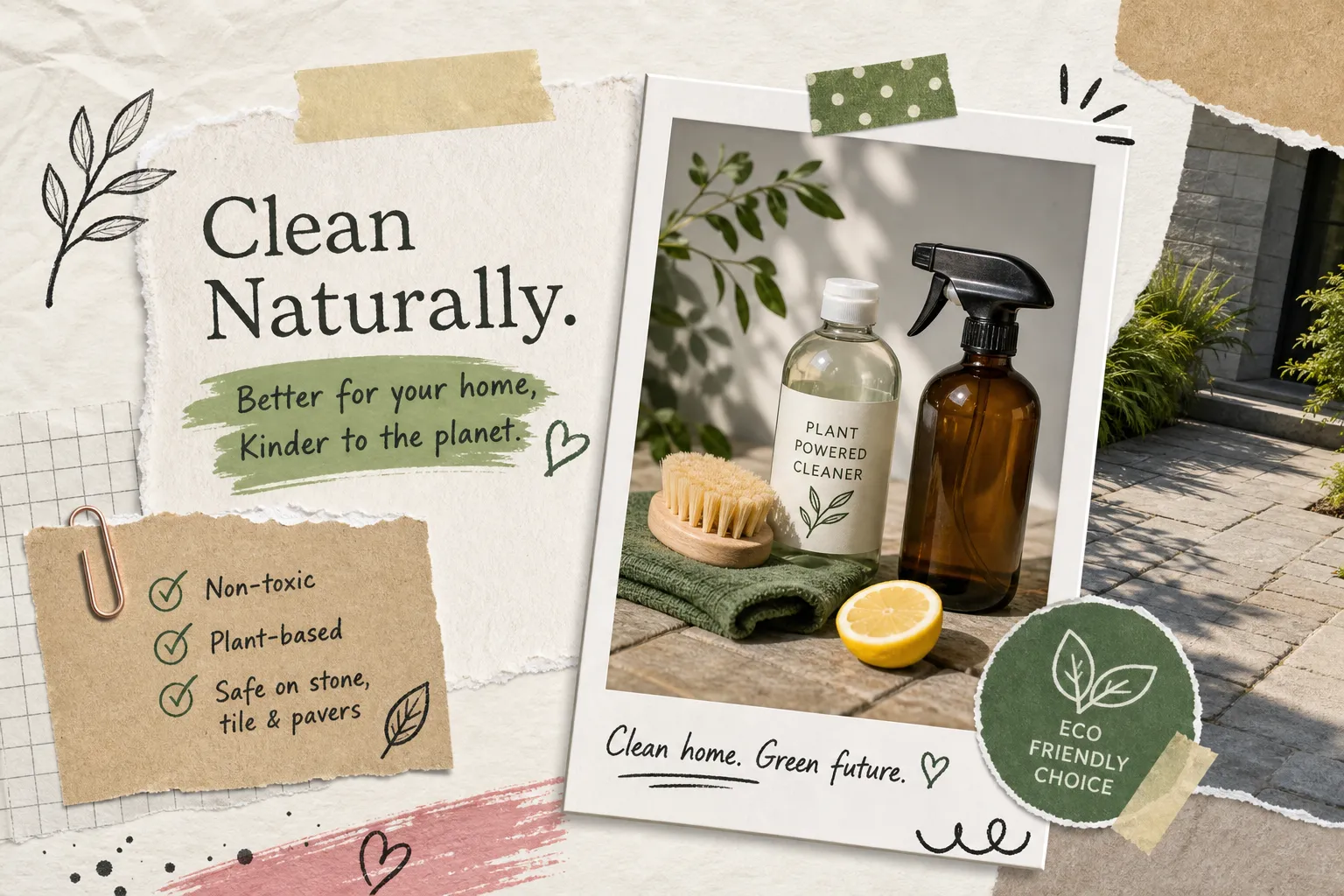
For day-to-day dust and light soil on sealed tile and pavers, a simple soap-and-water mix works well. Add a small amount of liquid castile soap to a spray bottle of water, shake, mist, and wipe. Follow with a damp cloth to rinse. It is gentle, effective on typical kitchen and bath messes, and leaves no harsh fumes.[14]
Here is the big red stop sign: never use vinegar on natural stone. Acid will etch marble, limestone, and travertine, and it can haze some engineered stones. If you are not sure the surface is acid-safe, assume it is not. Always spot test in a hidden corner and keep DIY mixes small and fresh.[1]
Professional-grade eco concentrates for tougher jobs
When you are facing oil stains on a driveway, efflorescence on concrete pavers, or algae on a shaded patio, you need more bite than dish soap. This is where biodegradable, low-VOC concentrates designed for hard surfaces shine. They pair safer, modern surfactants with the right pH window so you lift soils without chewing up sealers or stone. Look for eco friendly cleaning chemicals with clear dilution guidance so you can use the least product that gets the result.
A simple buying checklist for eco-friendly cleaners in North America
Where to find certified options and other suitable alternatives
You can find mainstream eco options at major retailers, and many refill stores stock local brands that lean into transparency and refills. Use the ECOLOGO, Green Seal, and Safer Choice product finders to locate formulas sold in Canada and to verify certifications before you buy.[7][8][9]
For a curated list of stone-safe options, see our Eco Friendly Cleaning Chemicals for Stone, Concrete, Tile, and Grout page, which highlights product types and surface compatibility to help you choose. You can also browse EPA Safer Choice-listed products directly via their product listings for additional verification (EPA Safer Choice product listings).
That last piece matters, because a "green" glass cleaner may be fine for windows but wrong for honed marble. Category fit beats category buzzwords. Choose a cleaner that lists its surface compatibility and pH, not just a leafy logo.
The five-point checklist before you buy
- Start with a credible certification: ECOLOGO, Green Seal, or Safer Choice.
- Scan the ingredient list for red flags: bleach, ammonia, phosphates, APEs, quats, and vague "fragrance."
- Verify the pH sits near neutral and is appropriate for your surface type.
- Prefer concentrates over single-use when possible to cut waste and cost.
- Look for full ingredient disclosure; if a brand will not say what is inside, that is your answer.
If you want to road-test a new cleaner, start on an inconspicuous spot and time your results. A good stone-safe formula lifts soil without a film, leaves grout its original color, and rinses clean in one to two passes. Small tests beat big regrets.
Conclusion
Eco friendly cleaning chemicals for stone, tile, and pavers are not just about being nice to rivers. They protect the finish you paid for and keep patios, bathrooms, and walkways crisp for years. The difference between a greenwashed bottle and a genuinely safer cleaner comes down to certifications, ingredient transparency, and the right pH for your material.
Start with neutral to mildly alkaline, low-VOC formulas that use biodegradable surfactants, and lean on trusted labels like ECOLOGO, Green Seal, and Safer Choice. For tougher jobs, choose concentrates you dilute on-site to cut waste and cost while staying stone-safe.
Your surfaces and your drain both come out ahead, and future you will not be chasing stains every long weekend. That is a clean win. For French-language guidance on cleaner options, see our French resource: Eco Friendly Cleaning Chemicals for Stone, Concrete, Tile, and Grout (French).

